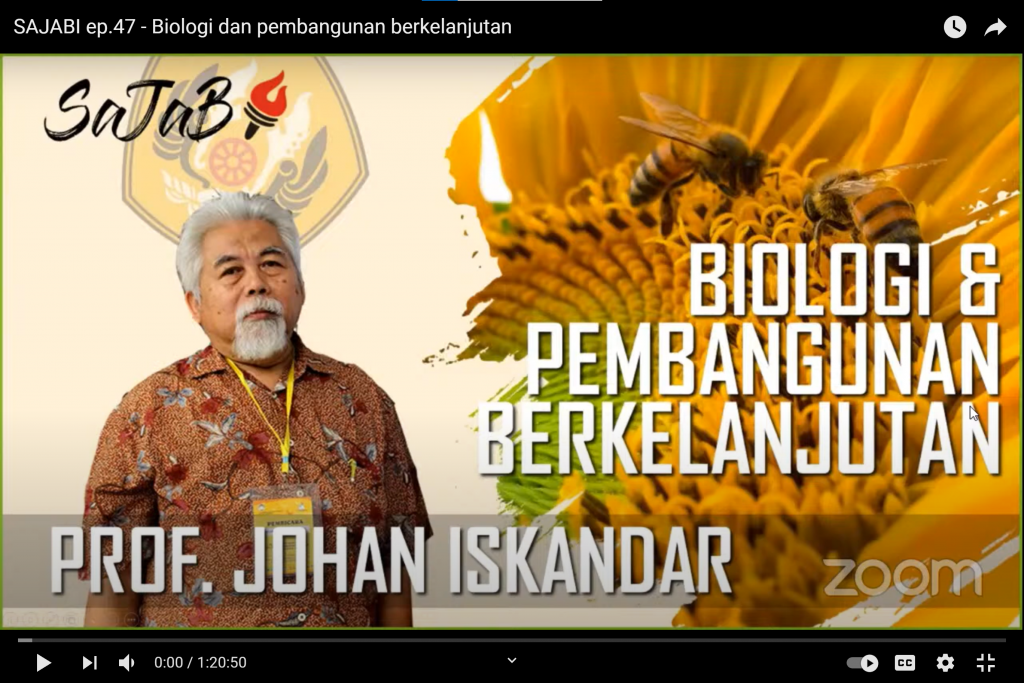
[unpad.ac.id, 20/09/2021] Biodiversity and cultural diversity, which are the basis of local knowledge, are important assets for sustainable development in Indonesia. The diversity that Indonesia has will be very beneficial if it can be optimized.
“Indonesia is truly extraordinary, blessed by God with a high biodiversity, including ethnic diversity, which is reflected in its local languages,” said Professor of the Faculty of Mathematics and Natural Sciences, Padjadjaran University, Prof. Dr. Johan Iskandar, M.Sc., during the One Hour Discussion on Science “Biology and Sustainable Development” held online by the Unpad Professors Council on Saturday (18/9).
According to Prof. Johan, currently many studies have been carried out from various disciplines based on local community knowledge, such as ethnobiology, ethnoecology, ethnobotany, and others. In addition to developing science and research publications, this study can also support sustainable development.
“Hopefully, the practical results will help sustainable development programs,” said Prof. John.
One example, the discovery of new drugs can be done by examining the local knowledge of the population that has been practiced for generations. This local knowledge, if studied further and combined with modern knowledge, can produce new discoveries to support sustainable development.
According to Prof. Johan, the study of ethnobiology and ethnoecology does not examine the biological and social aspects partially, but becomes a holistic study that is multi or transdisciplinary. Thus the study cannot be carried out in a monodiscipline.
“The results of the study may still need to be continued for downstreaming by collaborating with various fields of science. It is hoped that various local knowledge and management must also be hybridized or combined with western knowledge so that it is very useful for sustainable development which is now paying attention to the community, not only being top-down,” he said.*